
Global Point of Care

Webinars

What a Dress Size Can Teach Us About High-Sensitivity Troponin
Practical Interpretation, Sex‑Specific Cutoffs, & Confident Cardiac Disposition in Acute Care
Published August 04, 2026
Summary
In this educational webinar, high‑sensitivity cardiac troponin testing sits at the center of cardiac evaluation in the ED, ICU, observation units, and inpatient settings. Yet variability between assays, evolving guidelines, and ongoing debates around sex‑specific thresholds continue to create uncertainty in real‑world clinical decision‑making.
This global, healthcare-professional-focused educational webinar is designed for clinicians responsible for cardiac evaluation and disposition. The session will ground hs‑troponin interpretation in clinical context, workflow realities, and patient‑centered care—particularly for female patients, who remain at risk for under‑recognition of myocardial injury.
Learning Objectives
- Why hs‑troponin values differ across assays and why assay awareness matters at the bedside
- How to interpret assay‑specific 99th percentile cutoffs and serial changes in acute presentations
- Sex‑specific troponin cutoffs: what the evidence shows, why they matter for female patients, and how they may impact diagnosis, risk stratification, and disposition
- Practical considerations for integrating point‑of‑care and central laboratory troponin testing into ED and inpatient workflows
- Applying hs‑troponin results to support timely triage, safe rule‑out/rule‑in decisions, and confident disposition
This event is sponsored by Abbott.
Author / SPEAKER
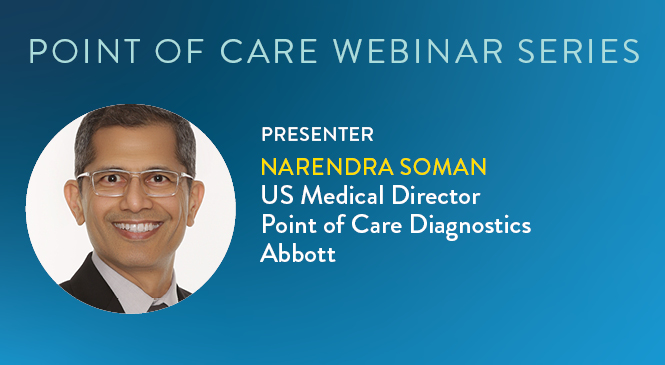
Narendra Soman, PhD
US Medical Director, Abbott | Point of Care Diagnostics
Narendra brings 20+ years of medical device experience and a passion for scientific exchange that elevates the quality of patient care. He champions meaningful scientific collaborations to advance impactful diagnostic solutions and led the development of Abbott’s i‑STAT hs‑TnI and TBI tests, helping bring cutting‑edge POC diagnostics to clinicians, helping to improve outcomes for patients when it matters most.
Titles of those appearing in the recording represent their roles at the time the webinar took place and may not reflect their current positions.
Who Should Watch
Cardiologist, Emergency department supervisor, Emergency Medicine physicians, Emergency Nursing Manager, POC managers/lead, Lab directors, Lab managers, Emergency Services, Ambulatory services, Biomedical scientists,