
Global Point of Care

Take Control of Diabetes
with HbA1c Testing
with HbA1c Testing




Take Control of Diabetes with HbA1c Testing
Rapid point-of-care testing for quick decisions on diabetes
The International Diabetes Federation (IDF) estimates that, as of 2024, approximately 589 million adults aged 20–79 years are living with diabetes worldwide. That's equivalent to 1 in 9 adults. Unfortunately, this number is projected to rise to approximately 853 million by 2050.1
Significantly, diabetes is a condition that can remain undiagnosed, sometimes for years. Almost one in two adults with diabetes remains undiagnosed.2 Type 2 diabetes accounts for the vast majority of cases globally. It is strongly associated with serious complications, including cardiovascular disease, chronic kidney disease, and vision loss, and represents a growing burden on patients and healthcare systems worldwide.1,3
Diabetes disproportionately affects people living in developing countries.

4 in 5 adults with diabetes (81%) live in low‑ and middle-income countries.2
Diabetes is one of the fastest growing global health emergencies of the 21st century.1
In 2024, over 9.5 million people worldwide were living with type 1 diabetes.4

Diabetes is one of the fastest growing global health emergencies of the 21st century.1
In 2024, over 9.5 million people worldwide were living with type 1 diabetes.4



Abbott is the world’s #1 provider of POC testing programs5
We’re changing disease management around the globe. We can help you and your staff manage diabetes in your patients with better outcomes for everyone.
Where Clinical Need Meets Patient Care
With the high rates of diabetes globally, and large groups of undiagnosed prediabetic patients it's likely you, as a primary care professional, encounter it every day. Testing, treatment, and compliance are the most effective ways to address diabetes. But, of course, these first rely on a diagnosis.
From the physician’s office to point-of-care sites in hospitals, rapid, reliable HbA1c testing helps to provide the clinical care that patients deserve. When patients have their tests and results on their first visit, they can manage prediabetes or diabetes more effectively.
Point-of-care testing enhances clinical efficiencies in busy practices and can help to stem the massive economic impact of diabetes around the world.
Diagnose Diabetes and Manage Patients with POC HbA1c Testing*
Point-of-care (POC) HbA1c testing allows for accurate test results,
diagnosis, and diabetes management counseling. Where central laboratory testing can take days before results are back, rapid diagnostics provide results in minutes.
With HbA1c point-of-care testing results on hand, you can create immediate coachable moments with your patients and educate them on their condition, empower them to take part in their own care, and adapt their treatment as required, minimizing the need for follow-up appointments.
STUDIES SHOW BENEFITS FOLLOWING POC TESTING IMPLEMENTATION 6,7,16:
- 61% reduction in patient revisits
- 89% fewer post-visit follow-up calls
- 85% fewer follow-up letters
- 3.7× reduction in missed HbA1c testing at the point of care
- Reduction in mean time to therapeutic intervention from 1376.7 hours to 1.6 hours
Increase Compliance for Better Patient Outcomes
Higher adherence to guideline‑recommended HbA1c testing frequency is associated with improved glycemic control over time in patients with type 2 diabetes.8 HbA1c testing at the point of care makes it easy and convenient for patients to be tested regularly since it only takes a few minutes and no extra lab visits or follow-ups are needed.
Patients are also more likely to test regularly when it’s quick and convenient for them. A minimally invasive finger stick blood sample is less time-consuming and less painful when compared to venous blood draw.17 It is also suitable for children and the elderly and individuals who are averse to needles.
Immediate availability of HbA1c results at the point of care has been associated with improved patient understanding and motivation for behavior change.11
Only 22% of U.S. adults with diagnosed diabetes achieved recommended targets for glycemic control, blood pressure, and cholesterol13
Clinical study results demonstrated:


POCT improved HbA1c testing adherence from 24% to 85%9


HbA1c POCT is associated with improved glycemic control10

Increase Compliance for Better Patient Outcomes
Higher adherence to guideline‑recommended HbA1c testing frequency is associated with improved glycemic control over time in patients with type 2 diabetes.8 HbA1c testing at the point of care makes it easy and convenient for patients to be tested regularly since it only takes a few minutes and no extra lab visits or follow-ups are needed.
Patients are also more likely to test regularly when it’s quick and convenient for them. A minimally invasive finger stick blood sample is less time-consuming and less painful when compared to venous blood draw.17 It is also suitable for children and the elderly and individuals who are averse to needles.
Immediate availability of HbA1c results at the point of care has been associated with improved patient understanding and motivation for behavior change.11
Only 22% of U.S. adults with diagnosed diabetes achieved recommended targets for glycemic control, blood pressure, and cholesterol13
Clinical study results demonstrated:

POCT improved HbA1c testing adherence from 24% to 85%9

HbA1c POCT is associated with improved glycemic control10
Afinion™ HbA1c is the #1 point-of-care test worldwide5
With its compact size and panel of tests, the Afinion 2 System is ideal for POC testing in physician offices, clinics, community health centers, retirement homes, emergency rooms, and hospital outpatient clinics.
The Afinion 2 analyzer demonstrates excellent analytical performance, with results comparable to laboratory HbA1c methods and meeting established NGSP and IFCC quality criteria. Certified by NGSP and IFCC, the Afinion 2 Analyzer showed excellent results in an independent performance study from the European Reference Laboratory for Glycohemoglobin.13, 14, 15
This test can be used as an aid in the diagnosis of diabetes and as an aid in identifying patients who may be at risk for developing diabetes.*
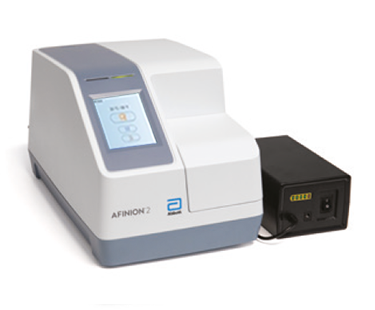
Afinion™ 2
The Afinion™ 2 analyzer is a compact, rapid, multi-assay analyzer that provides valuable near patient testing at the point-of-care. With the Afinion™ System, there’s no need to send test results to the lab or spend time tracking them down.
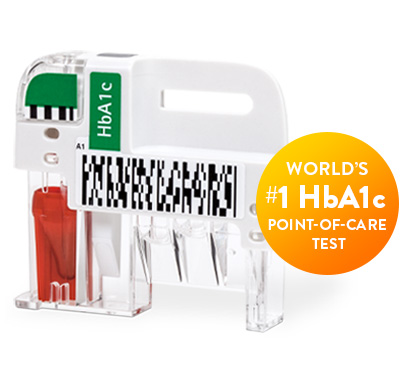
Afinion HbA1c
Test for quantitative determination of glycated hemoglobin (HbA1c) in human whole blood, used to monitor metabolic control in patients with diabetes.
References
*In the US, the Afinion HbA1c Dx test, indicated for the screening, diagnosis, and monitoring of diabetes, is available only in moderately complex clinical laboratory settings. The Afinion HbA1c test, intended for monitoring individuals with diabetes, is available for use in CLIA‑waived settings.
- International Diabetes Federation. IDF Diabetes Atlas, 11th ed. Brussels, Belgium: International Diabetes Federation; 2025. Accessed 15 July, 2026. https://diabetesatlas.org/resources/idf-diabetes-atlas-2025/
- International Diabetes Federation. IDF Diabetes Atlas: Global diabetes factsheet 2025. Brussels (Belgium): International Diabetes Federation; 2025. Highlights, p. 1.
- International Diabetes Federation. IDF Global Clinical Practice Recommendations for Managing Type 2 Diabetes – 2025. Brussels (Belgium): International Diabetes Federation; 2025.
- International Diabetes Federation. IDF Diabetes Atlas. 11th ed. Brussels (Belgium): International Diabetes Federation; 2025. Chapter 3: The global picture of diabetes; p.7.
- Data on file. Based on 2025 POC test worldwide sales. Includes Afinion HbA1c and NycoCard HbA1c sales.
- Crocker JB, Lynch SH, Guarino AJ, Lewandrowski K. The impact of point-of-care hemoglobin A1c testing on population health-based onsite testing adherence: a primary-care quality improvement study. J Diabetes Sci Technol. 2021;15(3):561-567. doi:10.1177/1932296820972751.
- Goodhart A, Johnson H, Bodkins E, Samek K. Impact of point of care hemoglobin A1c testing on time to therapeutic intervention. J Am Board Fam Med. 2024;37(4):790-791. doi:10.3122/jabfm.2023.230425R1
- Imai C, Li L, Hardie RA, Georgiou A. Adherence to guideline-recommended HbA1c testing frequency and better outcomes in patients with type 2 diabetes: a 5-year retrospective cohort study in Australian general practice. BMJ Qual Saf. 2021;30(9):706-714. doi:10.1136/bmjqs-2020-012026.
- Al Hayek AA, Al-Saeed AH, Alzahrani WM, Al Dawish MA. Assessment of patient satisfaction with on-site point-of-care HbA1c testing: an observational study. Diabetes Ther. 2021;12(11):3023-3035. doi:10.1007/s13300-021-01126-7.
- Gourlay A, Sutherland C, Radley A. Point-of-Care testing of HbA1c levels in community settings for people with established diabetes or people at risk of developing diabetes: A systematic review and meta-analysis. Prim Care Diabetes. 2024 Feb;18(1):7-16. doi: 10.1016/j.pcd.2023.10.011. Epub 2023 Nov 2. PMID: 37925311.
- Hirst JA, Farmer AJ, Williams V. How point-of-care HbA1c testing changes the behaviour of people with diabetes and clinicians: a qualitative study. Diabet Med. 2020;37(6):1008-1015. doi:10.1111/dme.14219
- Fang M, Wang D, Coresh J, Selvin E. Trends in Diabetes Treatment and Control in U.S. Adults, 1999-2018. New England Journal of Medicine. 2021;384(23):2219-2228. doi:10.1056/NEJMsa2032271
- Lenters-Westra E, Singh P, Vetter B, English E. Challenges in HbA1c point-of-care testing: only 5 of 19 HbA1c point-of-care devices meet IFCC and NGSP certification criteria on independent evaluation. Clin Chem. 2025;71(7):775-788. doi:10.1093/clinchem/hvaf059 https://academic.oup.com/clinchem/article/71/7/775/8148925
- National Glycohemoglobin Standardization Program. Protocol: Harmonizing Hemoglobin A1c Testing. Updated August 2024. Accessed July 28, 2026. https://ngsp.org/docs/Protocol.pdf
- Certificate Manufacturers. International Federation of Clinical Chemistry and Laboratory Chemistry.
http://ifcchba1c.org/GeneralInformation.aspx?I=14. Accessed May 16, 2026. - Crocker JB, Lee-Lewandrowski E, Lewandrowski N, Baron J, Gregory K, Lewandrowski K. Implementation of point-of-care testing in an ambulatory practice of an academic medical center. Am J Clin Pathol. 2014;142(5):640-646. doi:10.1309/AJCPYK1KV2KBCDDL
- Lian J, Liang Y. Diabetes management in the real world and the impact of adherence to guideline recommendations. Curr Med Res & Op. 2014; 30(11):2233–2240