
Global Point of Care

i-STAT hs-TnI Cartridge
Providing lab-quality results fast when every minute counts.
With i-STAT High Sensitivity Troponin-I (hs-TnI), healthcare professionals can quantify cardiac troponin I (cTnI) in approximately 15 minutes without leaving the patient's side.

Benefits
Incorporating the i-STAT hs-TnI test early in the patient experience can accelerate assessments of suspected myocardial infarction (MI), thereby improving triage efficiency.
- High Sensitivity cardiac troponin is recommended by ACC/AHA guidelines1 as the preferred biomarker for detecting MI.
- The Fifth Universal Definition of Myocardial Infarction recommends hs-cTn assays for routine clinical use.2
- Use of bedside testing in the ED has been shown to reduce:
- Time to anti-ischemic therapy by approximately 45 minutes3
- ED length of stay by 1.9 hours4
Cartridge Details
| Cardiac Markers |
| Cardiac Troponin I (cTnI) |
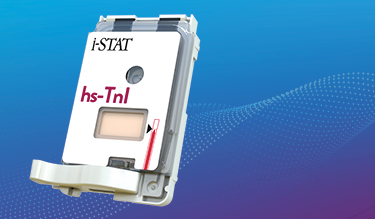
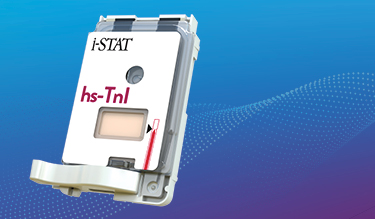
Access comprehensive materials and support for implementing the i-STAT hs-TnI cartridge.
Helpful Documents
PRODUCT DOCUMENTS
- hs-TnI Cartridge IFU (793033-00A.pdf )
- hs-TnI Control Levels 1-3 (798050-01A.pdf)
- hs-TnI Calibration Verification Levels 1-3 (798051-01A.pdf)
- i-STAT hs-TnI Product Specifications
- i-STAT hs-TnI Brochure
- To access product labeling documents click one of the following: Instructions for Use, Value Assigment Sheets, Documentation,
or Safety Data Sheets.
Customer Stories
- Newark 24/7 Urgent Care Center System Wide-Impact | Use Case | Erin Watson (PDF 934 KB)
- Accelerating Assessment of Suspected ACS: i-STAT hs-TnI in Action (PDF 940 KB)
- Abstract Summary | Can Point-Of-Care High-Sensitivity Troponin Improve Efficiency: A Multisite US Study | Simon Mahler, et al (PDF 308 KB)
SPECIFICATIONS
hs-TnI - INTENDED USE
The i-STAT hs-TnI cartridge with the i-STAT System is intended for use in the in vitro quantification of cardiac Troponin I (cTnI) in whole blood or plasma samples in point of care or clinical laboratory settings.
The i-STAT hs-TnI cartridge with the i-STAT System is intended to be used as an aid in the diagnosis of myocardial infarction (MI).
- DESCRIPTION: The i-STAT hs-TnI cartridge uses an enzyme-linked immunosorbent assay (ELISA) method with electrochemical detection of the resulting enzyme signal. The test reports a quantitative measurement of the sample concentration of cTnI in units of ng/L in approximately 15 minutes.
- SAMPLE SIZE: ≈ 22μL
- SAMPLE TYPE:
- Whole blood and plasma collected with lithium heparin
- Whole blood without anticoagulant (sample must be tested immediately (within 3 minutes of collection))
Expected Values
| Cardiac Markers |
| Reportable Range | |
| High Sensitivity Troponin-I (hs-TnI) | 2.9-1000.0 ng/L (pg/mL) |
Reference ranges (sometimes referred to as normal ranges) in the default Customization profile can be found on the i-STAT Instructions
for Use (IFU) page.
| Limit of Measurement | |||
|---|---|---|---|
| Sample Type | LoB (ng/L) | LoD (ng/L) | LoQ (ng/L) |
| Whole Blood | 0.78 | 1.61 | 2.9 |
| Plasma | 0.57 | 1.05 | 1.18 |
| Sex-Specific Cut-offs* | ||||
|---|---|---|---|---|
| Cut-Point (ng/L) | 90% CI (ng/L) | WB (%CV) | Plasma (%CV) | |
| Female | 13 | (10, 17) | < 5.2% | < 3.1% |
| Male | 28 | (19, 58) | < 5.1% | < 4.9% |
| Overall | 21 | (14, 30) | < 5.1% | < 4.9% |
*Comprehensive information on the Precision Study can be found in the Abbott i-STAT hs-TnI IFU.
PRODUCT CODES
| i-STAT System | Code | Quantity per Box |
|---|---|---|
i-STAT High Sensitivity Troponin-I (hs-TnI) | 09P81-25 | 25 |
| i-STAT hs-TnI Control Level 1 | 06P17-21 | 6 |
| i-STAT hs-TnI Control Level 2 | 06P17-22 | 6 |
| i-STAT hs-TnI Control Level 3 | 06P17-23 | 6 |
| i-STAT hs-TnI Calibration Verification Levels 1-3 | 06P17-20 | 6 (2 vials for each calibration verification level) |
Related Products
References
- Gulati M, Levy PD, Mukherjee D, et al. 2021 AHA/ACC/ASE/CHEST/SAEM/SCCT/SCMR Guideline for the evaluation and diagnosis of chest pain: Executive summary: A report of the American College of Cardiology/American Heart Association Joint Committee on Clinical Practice Guidelines. Circulation 2021;144(22):e368–e454;
- Mills, N. L., Newby, L. K., Zaman, S., Almahmeed, W. A., Bucciarelli-Ducci, C., Colvin, M. M., Dangas, G. D., DeVon, H. A., Dharmakumar, R., Gaziano, T. A., Hausenloy, D. J., Jeilan, M., Koskinas, K. C., Lindahl, B., Motovska, Z., Rubini Gimenez, M., Salvati, A. M., Tamis-Holland, J. E., & ESC/ACC/AHA/WHF Universal Definition Document Advisory Group. (2026). Fifth Universal Definition of Myocardial Infarction (2026). Journal of the American College of Cardiology. https://doi.org/10.1016/j.jacc.2026.07.025
- Renaud B, Maison P, Ngako A, et al. Impact of point-of-care testing in the emergency department evaluation and treatment of patients with suspected acute coronary syndromes. Acad Emerg Med. 2008;15:216-224.
- Singer AJ, Ardise J, Gulla J, Cangro J. Point-of-care testing reduces length of stay in emergency department chest pain patients. Ann Emerg Med. 2005;45:587-591